

Music Business
Australian Musicians Launch New Alliance to Challenge AI Copyright Changes
More than 150 Australian musicians have formed a new artists alliance over AI copyright. Here's what the debate means for independent artists and producers.
AudToro Team · Nov 3, 2026 · 17 min read
Today's Story: Australian Musicians Launch New Alliance to Challenge AI Copyright Changes
More than 150 Australian musicians have joined a newly established advocacy organization, the Artists Alliance of Australia (AAA), as concerns intensify over proposals that could change how artificial intelligence companies obtain permission to use copyrighted music.
The organization launched on October 29, 2026, founded by musicians Jack River and KLP, with support from artists including Bernard Fanning, Paul Dempsey, Kate Ceberano, and Troy Cassar-Daley.
The development follows new Australian music-industry polling released October 26 showing that 78% of surveyed adults favor retaining permission requirements for AI training, even if some technology companies consequently choose not to train models in Australia.
The central issue is whether creators should have to grant permission before their work is used for AI training, or whether certain uses could be permitted unless rights holders actively opt out. No such broad change has been enacted. The Music
Editorial Note: What's New?
This article covers a distinct development from AudToro's previous five editions:
- October 23: Spotify–Believe/TuneCore AI remix licensing.
- October 24: UMG–TYGER gaming music licensing.
- October 26: Eminem's unreleased-recording copyright case.
- October 28: RBX's dismissed Spotify streaming-fraud lawsuit.
- October 30: Universal Music Group's quarterly streaming and physical-sales results.
Today's article focuses on artist representation, AI training consent, and potential copyright-law changes, rather than AI-generated remixes or individual infringement litigation.
The new alliance's October 29 launch is the news event. Earlier government proposals and the October 26 survey provide essential context.
SEO Publishing Package
| Element | Recommendation |
|---|---|
| Primary keyword | Australian Artists Alliance AI copyright |
| Secondary keywords | Artists Alliance of Australia, AI music copyright 2026, AI training music rights, Australian AI copyright law, musicians AI rights |
| SEO title | Australian Artists Alliance: AI Copyright Fight Explained |
| Title length | 57 characters |
| Meta description | More than 150 Australian musicians have formed a new artists alliance over AI copyright. Here's what the debate means for independent artists and producers. |
| Description length | 156 characters |
| URL slug | /blog/australian-artists-alliance-ai-copyright-2026 |
| Category | Music Industry News |
| Tags | AI Music, Copyright, Artists Alliance of Australia, Music Producers, Independent Artists, Music Licensing, Artist Rights |
| Suggested schema | NewsArticle |
| Publication date | November 1, 2026 |
| Search intent | Current news, AI copyright education, music-business analysis |
Original Editorial Hero Image
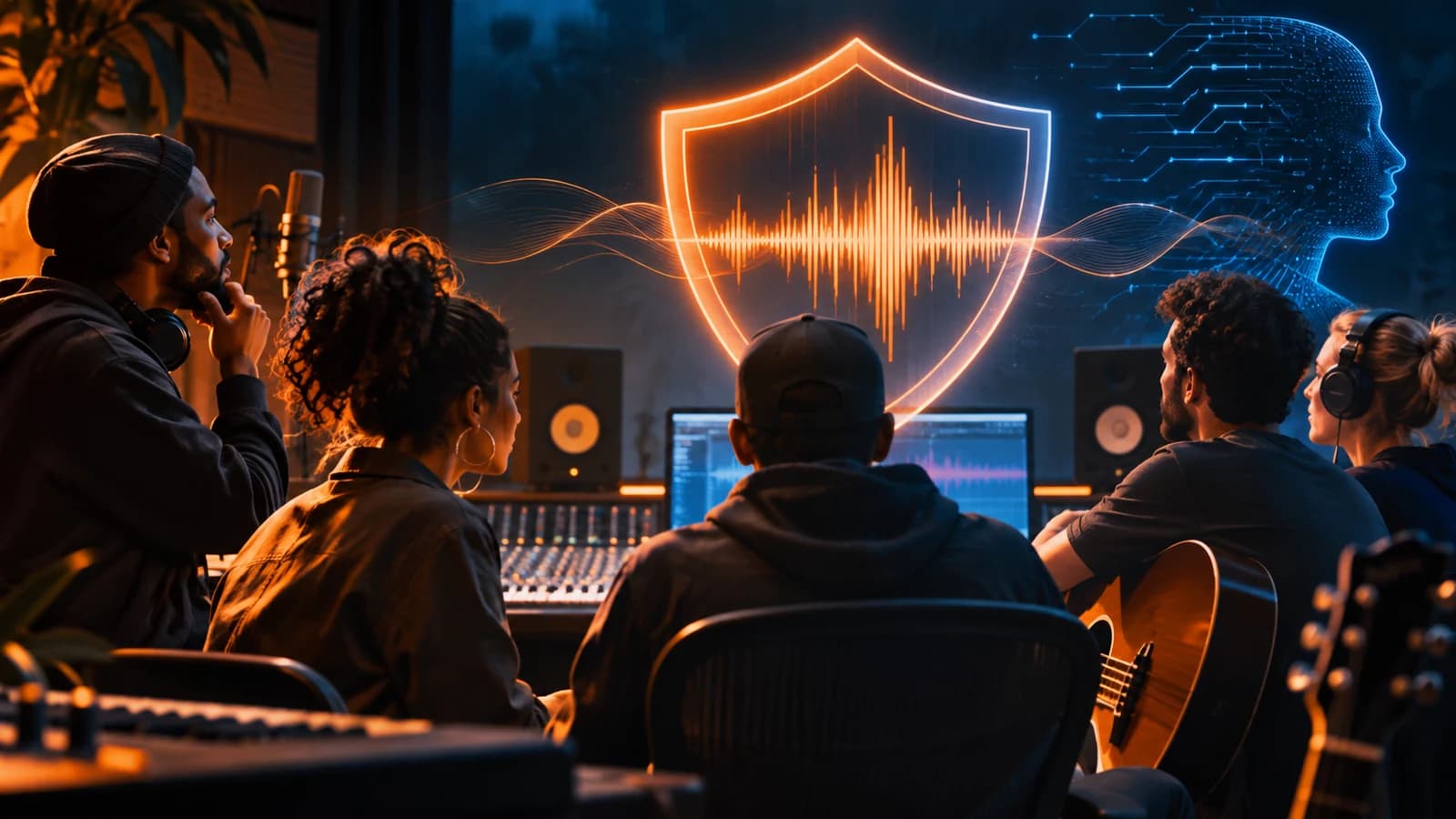
Caption: Editorial illustration: Australian musicians are organizing to defend creative rights as policymakers consider how copyrighted music may be used to train artificial intelligence.
SEO filename: australian-artists-alliance-ai-copyright-2026.webp
Accessible alt text: Musicians in a recording studio facing a glowing audio waveform shield and an abstract AI network, representing copyright protection and AI training.
Placement: Directly below the article headline, byline, and publication date.
The image is an original conceptual illustration. It does not depict the actual alliance members, a government hearing, or a specific AI company's technology.
More Than 150 Australian Musicians Unite Against AI Copyright Changes: What Independent Artists Need to Know
November 1, 2026 | Music Industry News | AudToro Editorial
The debate over artificial intelligence and music copyright is entering a new phase, and independent musicians are becoming more organized in their response.
On October 29, 2026, more than 150 Australian recording artists joined forces to launch the Artists Alliance of Australia (AAA), a new artist-led organization advocating for stronger representation in decisions affecting musicians' careers and intellectual property.
Founded by Jack River and KLP, the alliance includes support from established Australian performers such as Bernard Fanning, Paul Dempsey, and Kate Ceberano.
Its immediate priority is protecting musicians' copyright interests as Australian policymakers consider changes to how AI developers may use copyrighted material.
At the center of the dispute is a question with implications far beyond Australia:
Should artificial intelligence companies obtain permission before using copyrighted recordings and compositions to train their systems, or should creators be responsible for opting out?
The answer could influence future licensing arrangements, artist compensation, and the relationship between music creators and AI developers.
For independent producers, songwriters, and recording artists, understanding this debate is becoming an increasingly important part of managing their intellectual property. The Music
What Is the Artists Alliance of Australia?
The Artists Alliance of Australia is a newly established organization intended to represent recording artists in discussions about copyright, artificial intelligence, government policy, and other issues affecting the music industry.
Unlike a traditional record label or music distributor, the organization is focused on artist advocacy.
Its stated objectives include representing musicians, supporting their professional interests, connecting artists, and giving them a stronger voice in policy discussions.
The organization has begun welcoming community members and says copyright protection will be its first major advocacy priority.
The alliance's creation reflects growing concern that decisions about the future of music technology are being made without sufficient participation from the people who create the music.
Its founders argue that artists need meaningful representation when governments consider rules affecting the commercial use of their work.
The organization has not announced a comprehensive legislative proposal of its own.
Instead, its immediate focus is ensuring that musicians participate in ongoing discussions about copyright protections and AI training.
Readers can find its stated objectives on the Artists Alliance of Australia's official website.
Why Are Australian Musicians Concerned About AI Copyright?
The controversy involves possible changes to Australia's copyright framework.
Under traditional copyright licensing arrangements, companies generally need authorization when their intended use falls within rights controlled by a copyright owner and no legal exception applies.
For music, this can involve separate rights in sound recordings and musical compositions.
AI developers often need large collections of data to train generative models.
Depending on the system, training material may include text, images, audio recordings, musical compositions, or other content.
The legal treatment of these activities varies by country, and important questions remain contested.
In Australia, policymakers have been examining whether new licensing arrangements or copyright exceptions could make it easier for AI companies to access training material.
The concern among musicians is that certain proposals could shift responsibility away from technology companies obtaining permission and toward creators actively preventing use of their work.
What Does an AI Copyright Opt-Out System Mean?
An opt-out system would generally allow certain uses of material unless the rights holder takes an affirmative step to exclude it.
The precise consequences depend on how the system is designed.
For example, an AI developer might be permitted to use eligible online material for training unless its copyright owner has registered an objection through a specified process.
Such a framework could require artists to monitor new rules, identify relevant training activities, and understand how to exercise exclusion rights.
For independent musicians who manage their own catalogs, that could introduce additional administrative responsibilities.
However, it is important not to confuse a proposal with an enacted law.
Australia has not implemented a general new opt-out copyright system for commercial AI music training through the proposals currently being debated.
The potential changes remain subject to political and legal processes.
What Has the Australian Government Actually Proposed?
The policy debate has developed over several stages.
In October 2025, the Australian government publicly ruled out introducing a broad text-and-data-mining exception that would allow AI developers to use copyrighted works without permission.
At that time, the government emphasized protecting creative industries while examining potential approaches to AI licensing.
Those discussions included voluntary licensing, possible collective licensing arrangements, and mechanisms to improve copyright enforcement.
However, reporting in September 2026 revealed that government consultation materials had explored additional approaches.
According to the Australian Broadcasting Corporation's September 15 investigation, the materials outlined options involving opt-out arrangements for copyrighted material used in AI training.
One potential model involved payments through a collective body, while another approach contemplated licensing through organizations representing rights holders.
Critics argued that these arrangements could weaken the ability of individual creators to negotiate permission and compensation.
Supporters of more flexible AI training rules argue that existing licensing requirements can make it difficult to assemble sufficiently large datasets and may discourage investment or technological development.
The policy challenge is determining whether a workable system can support innovation while preserving meaningful creator rights and compensation.
The government's earlier rejection of a broad text-and-data-mining exception remains an important part of the record, but the later consultation proposals explain why musicians are concerned that the framework could change.
No final legislation implementing the reported opt-out proposals had been enacted as of November 1, 2026. Ministers Australia's Government
New Survey Finds Strong Support for Artist Permission
The launch of the Artists Alliance of Australia follows new research released by the Australian Recording Industry Association (ARIA).
On October 26, 2026, ARIA published results from a survey conducted by RedBridge Group.
The survey questioned 1,524 Australian adults between October 8 and October 10.
According to the results, 78% of respondents favored retaining the requirement for AI companies to obtain permission before using Australian creative works, even if some companies consequently chose not to train models in Australia.
Only 9% favored changing that requirement under the scenario presented.
The research also found that 74% believed creators should have the right to decide whether their work is used to train AI systems.
The survey was commissioned by ARIA, an organization advocating for the music industry's copyright interests.
Its results should therefore be understood in that context rather than treated as a neutral government referendum.
The published methodology states that respondents were recruited through online panels and that the results were weighted across several demographic categories.
The reported margin of error was approximately 3.3 percentage points.
The findings suggest substantial public support among those surveyed for retaining permission-based copyright protections. They do not, by themselves, determine what policy the government will adopt. ARIA
Why This Debate Matters Beyond Australia
Although the immediate controversy concerns Australian law, music is an international business.
An independent producer in the United States may collaborate with an artist in Australia, distribute recordings through international services, and license music to businesses operating in several countries.
Copyright protection and licensing requirements can differ between jurisdictions.
A change in Australian law would not automatically rewrite American copyright law or existing private contracts.
However, the rules adopted in one market can influence the business decisions of companies operating globally.
For example, a multinational AI developer may negotiate licenses covering recordings from several territories.
Its willingness to negotiate, the rights it seeks, and the compensation it offers can be affected by the legal environment in which it operates.
Likewise, music publishers and record labels may adjust licensing strategies in response to changing rules.
Independent musicians should therefore pay attention to international developments without assuming that every proposal immediately changes their own legal rights.
The larger issue is whether future AI music markets will primarily rely on negotiated permissions or broader statutory arrangements.
What Is the Difference Between AI Training and AI-Generated Music?
These concepts are related, but they are not interchangeable.
AI Training
AI training involves using data to develop or improve a model.
In music-related systems, that data may include recordings, compositions, or other information.
Whether a particular training activity requires authorization depends on the applicable law, the material used, and the circumstances.
AI-Generated Music
AI-generated music is audio or musical material produced using a generative AI system.
Some systems generate entire compositions, while others assist with specific production tasks.
The legal questions surrounding generated outputs can differ from those involving training data.
AI-Assisted Music Production
AI-assisted production may involve tools that help musicians separate stems, reduce noise, identify musical elements, or perform other technical tasks.
Using an AI-assisted production tool does not necessarily mean the musician has authorized a separate company to use their entire catalog for model training.
The distinction matters because artists may support some applications of AI while opposing others.
A producer might use AI-assisted audio restoration while still requiring explicit permission before their original recordings are incorporated into a commercial training dataset.
The Australian copyright debate is principally concerned with how copyrighted material may be used by AI developers, rather than whether musicians should be prohibited from using AI-assisted production tools.
How Could AI Copyright Changes Affect Independent Producers?
Independent producers frequently occupy several roles in the music business.
A producer might compose an instrumental, perform instruments, arrange a song, record vocals, and deliver a finished master.
Each activity can involve different ownership arrangements.
The potential implications of AI training become clearer when those rights are separated.
Ownership of Musical Compositions
A producer who writes original musical material may own part or all of the underlying composition, depending on applicable law and contractual arrangements.
That ownership can be relevant when a company seeks permission to use the composition.
Ownership of Sound Recordings
The master recording represents a separate category of rights.
A producer may own the master, share ownership, or transfer certain rights to an artist or another business.
Ownership cannot be determined simply from the fact that someone produced the track.
Beat Licensing
A producer who sells a beat license may grant an artist permission to use an instrumental in a finished recording.
The scope of that permission depends on the agreement.
A license allowing an artist to record and commercially distribute a song does not necessarily grant unrestricted rights to use the instrumental for training an AI model.
Conversely, some agreements contain broad licensing provisions that deserve careful review.
Collaborative Recordings
A finished song may involve multiple contributors with different rights.
An artist may control the master recording while producers and songwriters retain interests in the composition.
A company seeking to license the recording for a new purpose may need to address more than one category of rights.
These distinctions make clear documentation especially valuable as new music technologies emerge.
Could AI Music Licensing Become Another Revenue Source?
Potentially.
Music companies and AI developers have already begun negotiating commercial licensing agreements covering certain uses of copyrighted recordings and compositions.
Such agreements demonstrate that licensed AI development is a possible business model.
However, licensing terms can vary considerably.
Some arrangements may involve upfront payments, ongoing compensation, revenue sharing, or other negotiated consideration.
The existence of an agreement does not establish that every contributing artist or producer receives a separate royalty.
Payment depends on the rights involved and the contractual relationships between participants.
There is also an important distinction between an industry-wide licensing agreement and an individual creator's ability to negotiate directly.
Major rights holders may control extensive catalogs and have dedicated licensing teams.
Independent producers may control smaller catalogs and have fewer resources for evaluating complex agreements.
Collective licensing arrangements could potentially reduce transaction costs, but their effectiveness would depend on governance, participation rules, transparency, and how compensation reaches individual creators.
The Australian debate illustrates the challenge of designing systems that are commercially workable without leaving smaller rights holders at a disadvantage.
What Independent Artists Should Do Now
Musicians do not need to wait for new legislation before improving how they manage their intellectual property.
Several practical steps can help them prepare for future licensing opportunities and disputes.
1. Document Ownership of Your Recordings
Maintain clear records identifying who owns each master recording.
For collaborative projects, distinguish ownership from performance credits and production credits.
Those categories are not always equivalent.
2. Establish Songwriting Splits
When multiple people contribute to a composition, document their agreed ownership percentages.
Written split sheets and other appropriate agreements can help clarify how income should be administered.
3. Review Beat Licensing Terms
Producers should understand which rights they retain and which rights they grant to customers.
Where relevant, agreements can expressly address emerging uses, including AI training, derivative works, and other forms of commercial exploitation.
Contract language should be reviewed by qualified counsel when significant rights or revenue are involved.
4. Keep Accurate Catalog Records
Maintain organized records of recordings, compositions, contributors, release dates, and applicable identifiers.
Where assigned, identifiers such as ISRCs and ISWCs can help distinguish recordings and compositions.
Accurate metadata is useful for rights administration, but it does not automatically prevent unauthorized copying or AI training.
5. Review Distribution and Service Agreements
Before granting rights to a distributor, publisher, or other service provider, understand the permissions involved.
Pay particular attention to broad sublicensing provisions and any terms addressing machine learning or emerging technologies.
Do not assume every standard distribution agreement includes the same AI-related provisions.
6. Evaluate AI Licensing Offers Carefully
If a company requests permission to use music for AI development, consider what material is covered, how long the permission lasts, whether sublicensing is allowed, and what compensation is provided.
Artists should also understand whether the agreement permits future uses beyond the original training activity.
7. Follow Official Policy Developments
Creators should distinguish between government proposals, industry advocacy, enacted legislation, and court decisions.
These can have very different legal consequences.
In particular, artists should not assume that a universal AI training opt-out mechanism exists merely because one has been discussed.
Why Music Collaboration Platforms Have a Role to Play
The AI copyright debate reinforces the importance of clear relationships between artists and producers.
Before a song reaches a distributor, publisher, or technology company, its ownership often begins with agreements between the people who created it.
An artist may purchase a beat, book a recording session, work with a mixing engineer, and collaborate with several songwriters.
Those activities create a chain of creative contributions and contractual relationships.
Keeping project communications, deliverables, and agreements organized can make future rights questions easier to address.
AudToro connects independent artists with music producers and recording services while providing project workflows for collaboration.
Its beat marketplace also provides another way for producers to offer original instrumentals.
These services support music creation and commercial collaboration; they do not independently determine copyright ownership or guarantee protection against unauthorized AI training.
The underlying lesson is that artists benefit from understanding and documenting their rights before new commercial uses arise.
What Happens Next in Australia's AI Copyright Debate?
The Artists Alliance of Australia has announced its intention to begin advocating for copyright protection immediately.
Its effectiveness will depend on its ability to represent members, participate in policy discussions, and influence future decisions.
Meanwhile, Australian policymakers continue examining the relationship between AI development and copyright law.
A parliamentary inquiry into artificial intelligence is also underway, with a report expected on November 30, 2026.
That report may provide additional insight into the policy debate, although its publication would not automatically change existing law.
Several questions remain unresolved.
Will Australian policymakers formally advance an opt-out licensing proposal?
Will the government maintain its earlier position against a broad text-and-data-mining exception?
Could collective licensing arrangements provide meaningful compensation without weakening individual rights?
And how will independent musicians participate in decisions about the commercial use of their work?
The answers could influence future discussions in other markets, even though national copyright systems remain legally distinct.
Frequently Asked Questions
What is the Artists Alliance of Australia?
The Artists Alliance of Australia is an artist-led advocacy organization launched on October 29, 2026.
It aims to represent Australian recording artists on issues including copyright, artificial intelligence, and government policy.
Who founded the Artists Alliance of Australia?
The organization was founded by Australian musicians Jack River, whose real name is Holly Rankin, and KLP, whose real name is Kristy Lee Peters.
More than 150 artists were associated with its launch.
Why are Australian musicians concerned about AI?
Musicians are concerned that potential copyright reforms could make it easier for AI developers to use creative works for training without obtaining individual permission.
The debate also involves compensation and control over copyrighted material.
Has Australia changed its copyright law to allow unrestricted AI training?
No. The reported opt-out proposals remain part of a policy debate.
They should not be described as enacted law.
What is an AI copyright opt-out system?
An opt-out system generally permits certain uses unless the rights holder takes steps to exclude their material.
The exact rights and obligations depend on the applicable legal framework.
Can AI companies legally train on copyrighted music?
The answer depends on the jurisdiction, the circumstances, the rights involved, and applicable licenses or legal exceptions.
There is no single worldwide rule governing every AI training activity.
Do music producers own the copyright to their beats?
Producers may own rights in their original compositions and recordings, but ownership depends on the creative contributions, applicable law, and contractual arrangements.
Selling a beat license does not necessarily transfer every right associated with the underlying music.
Can artists receive royalties from AI music licensing?
Yes, where applicable agreements provide compensation to the relevant rights holders.
However, no universal AI music royalty rate applies to every licensing arrangement.
The Bottom Line
The launch of the Artists Alliance of Australia marks a new development in the international debate over music copyright and artificial intelligence.
More than 150 musicians have joined an organization seeking stronger representation as policymakers consider how copyrighted material may be used to train AI systems.
The central disagreement concerns the balance between technological development and creators' control over their work.
For independent artists and producers, the implications extend beyond Australia.
As AI-related music licensing develops, creators will need to understand who owns their recordings and compositions, what permissions they have granted, and how new commercial uses may affect their rights.
The most important preparation is not predicting every future AI technology. It is establishing clear ownership, maintaining accurate records, and understanding the agreements governing original music.
Those practices remain valuable regardless of how the current policy debate is resolved.
Sources and Further Reading
Primary source — Artists Alliance of Australia
Artists Alliance of Australia — Official Website and Mission
Launch reporting — October 29–30, 2026
The Music — More Than 150 Musicians Launch Artists Alliance of Australia
The Note — More Than 150 Australian Artists Join New Alliance
Primary industry research — October 26, 2026
ARIA — Four in Five Australians Say Don't Change Copyright Laws for Big Tech
Independent-label position — October 25, 2026
Australian Independent Record Labels Association — Opposition to AI Copyright Reform Proposals
Government policy and reporting
Australian Attorney-General — October 26, 2025 Copyright and AI Statement
ABC News — September 15, 2026 Investigation Into Proposed AI Copyright Changes